
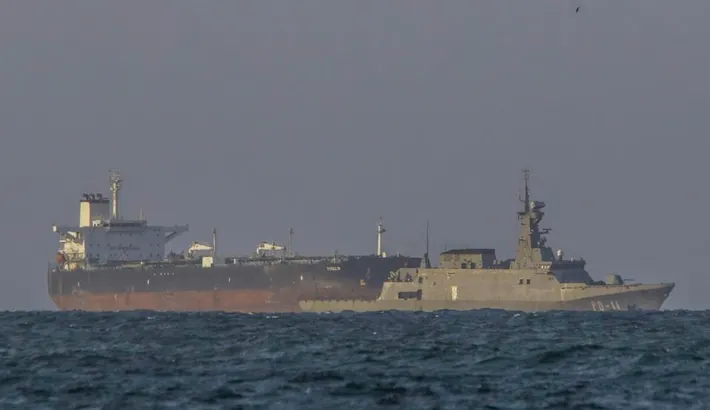
U.S. Seizes Massive Oil Tanker Near Venezuela, Raising Regional Tensions
The United States has intercepted and taken control of a large crude-oil tanker just off the Venezuelan coast, a move that is already intensifying the long-running friction between Washington and Caracas. President Trump confirmed the operation on Wednesday, signaling that the cargo onboard will likely remain in U.S. possession.
Speaking during a White House roundtable, the president described the vessel as “the largest tanker ever seized,” adding that the action was executed “for a very good reason.” He offered no further operational details but suggested the oil would be retained by U.S. authorities.
Venezuela Condemns the Operation
Venezuela’s government responded swiftly, calling the seizure an act of “international piracy” and accusing Washington of targeting the country for its natural resources. In a sharply worded statement, officials in Caracas argued that the incident exposes the “real motives” behind long-standing U.S. pressure.
According to the Venezuelan government, the confrontation has “never been about migration, narcotics, democracy, or human rights,” but rather about access to the country’s substantial oil reserves.
Inside the Mission to Capture The Skipper
Three sources familiar with the matter identified the tanker as The Skipper. The seizure began early Wednesday morning, around 6 a.m., and involved a combined force of special operations personnel, Coast Guard members, Marines, and aviation assets.
The helicopters used in the mission launched from the USS Gerald Ford, the Navy’s most advanced aircraft carrier, which recently positioned in the Caribbean as part of an expanded U.S. military presence. The boarding team drew from the Coast Guard’s Maritime Security and Response Team, an elite unit trained for high-risk interdictions.
Military officials confirmed that the Coast Guard led the operation, consistent with legal requirements governing maritime seizures. Although the U.S. has impounded sanctioned oil tankers before, conducting a fast-rope airborne boarding at sea remains relatively uncommon.
A Tanker with a Controversial History
U.S. Treasury Department sanctions placed The Skipper on a restricted list in 2022 for alleged ties to Iran’s Islamic Revolutionary Guard Corps and Hezbollah. The vessel previously operated under two different names—Adisa and The Toyo—and has been linked to illicit oil trading networks stretching across Venezuela and Iran.
Video shared on social media by Attorney General Pam Bondi showed parts of the operation, asserting that the ship had long been involved in transporting sanctioned crude. She noted that the seizure was executed by the FBI, Homeland Security Investigations, and the Coast Guard, with additional support from the Department of Defense.
More Operations May Follow
Officials say Wednesday’s action may signal an expansion of U.S. maritime interdiction efforts. For months, the administration has targeted suspected drug-smuggling vessels in both the Caribbean and the Pacific. Senior military officials indicate that similar missions could be authorized soon.
President Trump has also suggested that the U.S. may shift some operations from the sea to land, specifically inside Venezuela. During a recent Cabinet meeting, he said the administration “knows the routes, knows the networks, and knows where the bad actors live,” hinting that land-based strikes may soon be considered.
As U.S. naval forces continue to build up in the region—including fighter jets conducting flyovers near the Gulf of Venezuela—the seizure of The Skipper represents a turning point in an already volatile standoff.

