
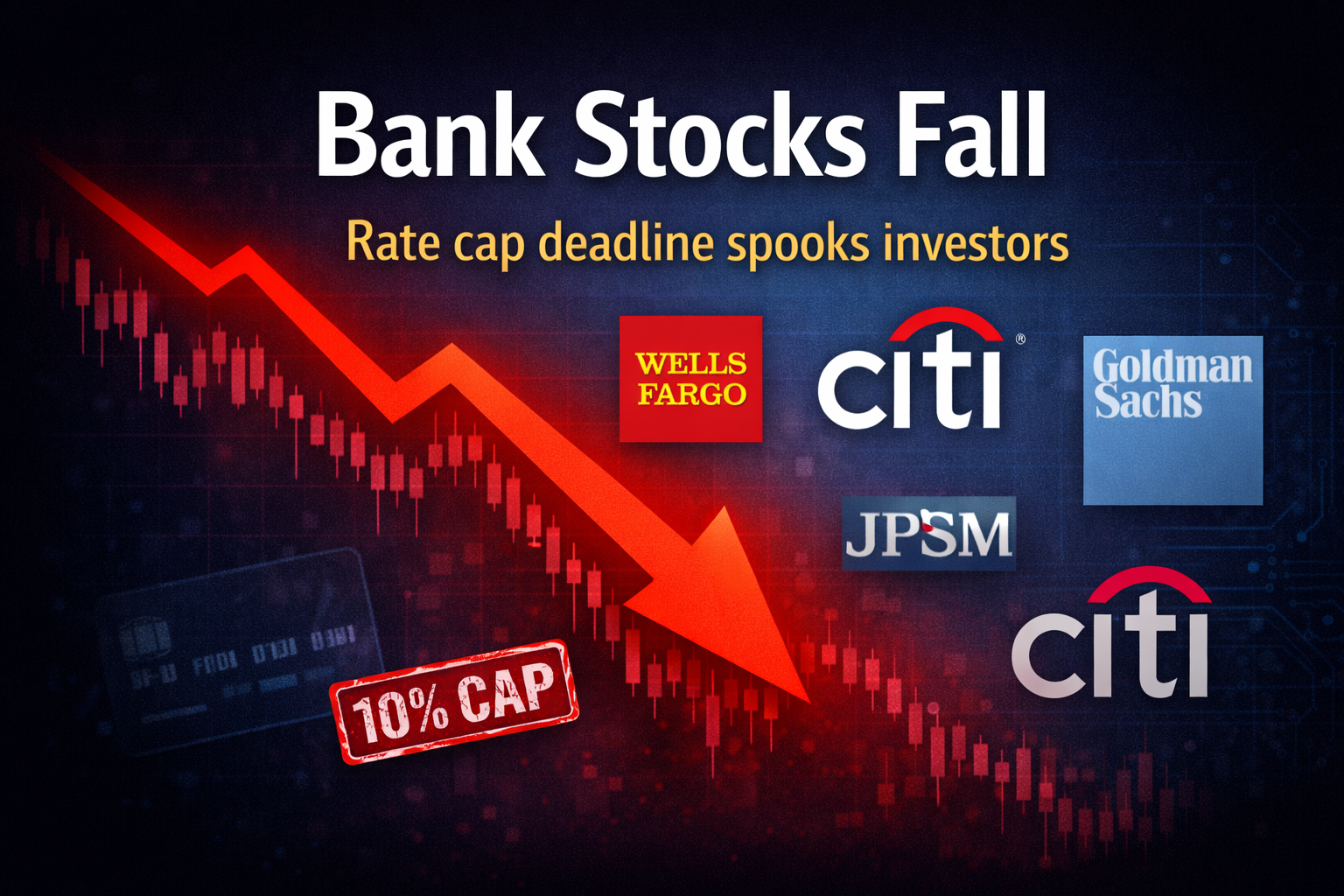
U.S. Bank Stocks Slide as Investors Watch Deadline for Trump’s 10% Credit Card Rate Cap
U.S. bank stocks declined Tuesday as investors weighed the potential impact of a proposed 10% cap on credit card interest rates, with a Trump administration deadline putting the issue back in focus across Wall Street.
The policy proposal has created a fresh source of uncertainty for large lenders—because credit card interest income is a major profit engine for consumer banking, and a broad rate ceiling could force issuers to rethink who qualifies for unsecured credit.
Major U.S. financial institutions, including JPMorgan Chase, Citigroup, Wells Fargo, Morgan Stanley, and Goldman Sachs, traded lower alongside a decline in the broader banking index.
Why a credit card rate cap matters to markets
A hard cap on credit card APRs isn’t just a consumer headline—it goes straight to how banks price risk.
Credit cards are unsecured loans, meaning banks depend on interest rates to cover:
- borrower default risk
- fraud and charge-offs
- operational costs and funding
- rewards programs and card benefits
Banks argue that if the cap is too low, lenders could have no choice but to tighten approval standards, reduce credit limits, or increase fees to maintain profitability.
Citi CEO: Congress may not approve a rate cap
Citigroup CEO Jane Fraser said she does not expect Congress to approve a credit card interest rate cap, suggesting the proposal could face serious resistance on Capitol Hill.
Fraser acknowledged the focus on affordability but warned that limiting rates could have broader economic consequences, including reduced borrowing access that could affect consumer-driven industries.
How big could the impact be? Industry warns of reduced access
Banking groups are pushing back hard, arguing that a 10% cap could significantly reduce consumer credit availability.
The American Bankers Association estimated that 137 million to 159 million Americans could lose access to credit cards if the cap were implemented across the board.
Is a compromise possible?
Analysts believe a political compromise may emerge rather than a strict nationwide rate ceiling.
Some observers have suggested banks could voluntarily introduce lower-rate card products with fewer features—an approach that could address consumer affordability concerns without forcing a hard legislative cap.
What investors should watch next
1) Whether the administration takes concrete enforcement steps
Markets will react more aggressively if the plan moves from headline to actual policy implementation.
2) Signs of legislative support (or lack of it)
If Congress signals strong opposition, the market could treat the risk as short-lived.
3) Any alternative framework banks can agree to
A voluntary product compromise could ease uncertainty and limit downside risk to credit card profitability.
Final Takeaway
The banking sector is facing a new policy-driven risk: a potential 10% credit card interest rate cap that could reshape how lenders price unsecured consumer credit. Until investors get clarity on whether the deadline becomes enforceable policy—or turns into a compromise—bank stocks may remain volatile.

